
Can Sciatica Cause Foot Numbness? What Your Symptoms may Mean

Can sciatica cause foot numbness? Yes. When a nerve in the lower back becomes irritated or compressed, sciatica can cause numbness, tingling, or weakness that travels into the leg and foot.
Where you feel the numbness may provide clues about which nerve is affected. However, foot numbness can have other causes, so the pattern of symptoms needs to be considered before deciding on treatment.
Can sciatica cause foot numbness?
Sciatica occurs when a nerve root that contributes to the sciatic nerve becomes irritated or compressed. Because these nerves carry signals between the lower spine, leg, and foot, sciatica can affect both sensation and muscle function.
Symptoms may include:
- Sharp, burning, or shooting leg pain
- Tingling or pins and needles
- Numbness in the leg, foot, or toes
- Weakness in the leg, ankle, or foot
Some people mainly experience pain, while others notice numbness or tingling farther down the leg.
Where does sciatica cause numbness in the foot?
The location of numbness can sometimes provide clues about the nerve root involved. L5 and S1 nerve roots are commonly associated with symptoms that extend into different areas of the foot.
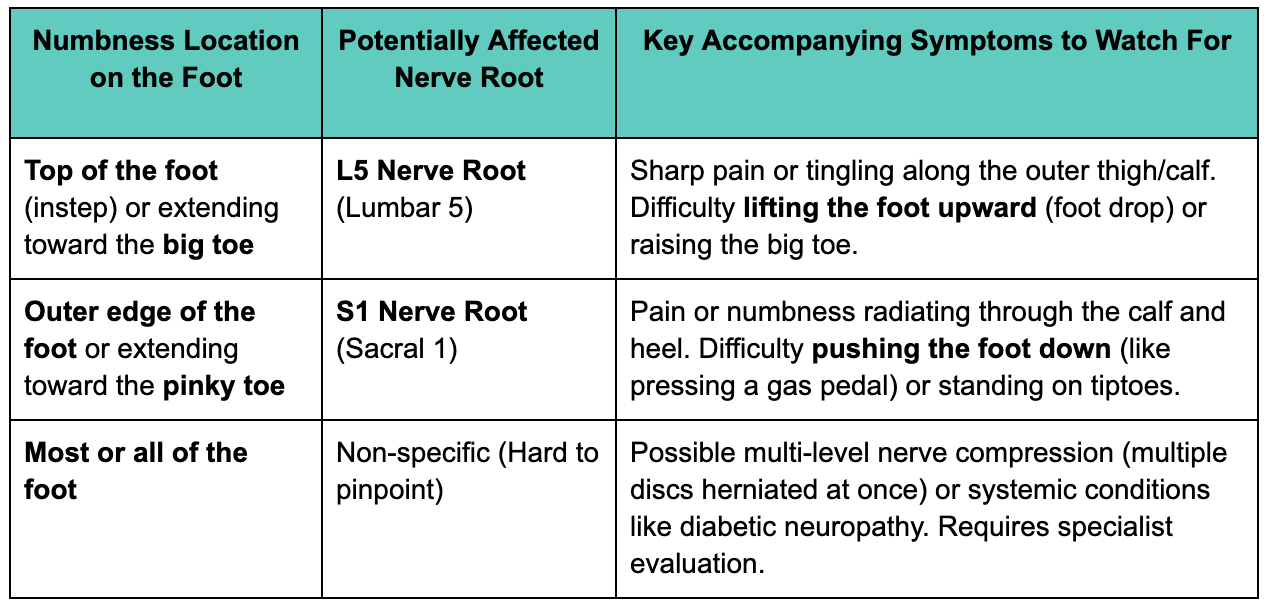
However, these sensory patterns are not absolute. Because nerve pathways frequently overlap, numbness in a specific toe or area alone is not enough to pinpoint the exact nerve root involved.
Numbness on the top or outside of the foot
L5 nerve root irritation may affect sensation over the top of the foot and toward the big toe. S1 irritation may cause numbness or tingling toward the outer foot and may also affect the calf.
When muscle function is involved, L5 symptoms may include difficulty lifting the foot or big toe, while S1 involvement may affect movements that push the foot downward.
Can the whole foot feel numb?
It can, but widespread foot numbness is less specific to a single nerve root. Sciatica is also not the only possible cause. Persistent or spreading numbness should be evaluated rather than assumed to come from the lower back.
Why can sciatica make your foot numb?
Sciatica describes a group of nerve symptoms rather than a single condition. When a nerve root in the lower back becomes irritated or compressed, changes in sensation can travel down the leg and into the foot.
Several conditions can contribute:
- Herniated or bulging disc: Disc material can irritate or place pressure on a nearby nerve root, causing pain, tingling, or numbness into the leg and foot. A bulging disc in the lower back does not always cause symptoms, but nerve related symptoms can occur when a nearby nerve is affected.
- Spinal stenosis: Narrowing around the nerves can reduce the space available for nerve roots and contribute to leg or foot symptoms.
- Degenerative changes: Changes in spinal discs and joints over time can also reduce space around a nerve root.
Finding the underlying cause matters because foot numbness alone does not show what is affecting the nerve.
Foot numbness vs other sciatica symptoms
Sciatica can affect sensation and muscle function in different ways, so symptoms may vary from person to person. Foot numbness may occur alone or together with pain, tingling, or weakness elsewhere in the leg.
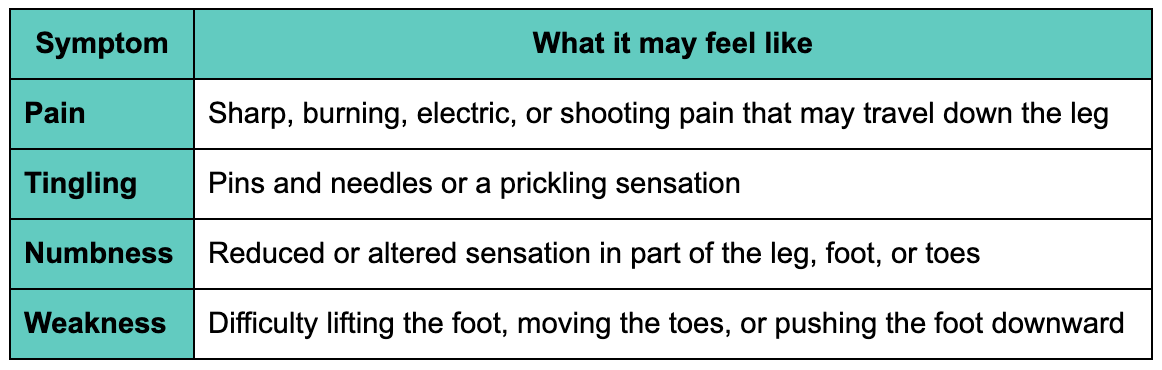
You may experience one main symptom or a combination of several. Foot numbness that occurs with pain traveling from the buttock into the leg may suggest nerve irritation in the lower spine, but other causes should be considered when the pattern is unclear.
When is foot numbness from sciatica a warning sign?
New or worsening numbness deserves attention, especially when it occurs with muscle weakness.
Seek urgent medical attention if foot numbness occurs with:
- New or rapidly worsening leg weakness: This may include increasing difficulty lifting the front of the foot.
- Loss of bladder or bowel control: New difficulty controlling urination or bowel movements.
- Saddle numbness: Loss of or altered sensation around the groin, buttocks, or inner thighs.
- Severe symptoms affecting both legs: New or rapidly worsening weakness, numbness, or other neurological changes.
These symptoms can be associated with serious compression of the nerves in the lower spine and require urgent medical evaluation.
Without these warning signs, foot numbness is not necessarily an emergency. However, new, spreading, persistent, or worsening numbness should still be evaluated.
How is sciatica with foot numbness evaluated?
Evaluating sciatica involves more than identifying where your foot feels numb. The goal is to see how the pattern of symptoms matches the findings from a physical examination.
Your healthcare provider may first ask:
- Where the numbness begins and how it travels through the leg or foot.
- Which positions or activities make the symptoms better or worse.
- Whether you also have lower back pain, leg pain, tingling, or weakness.
Physical and neurological examination
The examination can help determine whether a nerve in the lower back may be involved. It may include:
- Sensation: Checking whether feeling is reduced or different across areas of the leg and foot.
- Strength: Testing movements of the legs, ankles, feet, and toes for weakness.
- Reflexes: Checking certain reflexes when appropriate.
- Movement: Assessing lower back and leg movement. Specific tests, such as the straight leg raise, may also be used when appropriate.
When is imaging needed?
Imaging is not always necessary right away. It may be considered when symptoms persist, neurological changes are significant or worsening, or the examination suggests a closer look at the spine is needed.
Imaging findings should be considered with your symptoms and examination. A bulging or herniated disc on an MRI does not automatically mean it is causing your foot numbness.
What are the treatment options for sciatica and foot numbness?
Treatment depends on the cause of the nerve irritation, the severity of your symptoms, and whether numbness is accompanied by weakness or other neurological changes.
Activity and movement changes
For uncomplicated sciatica, prolonged bed rest is generally not recommended. Comfortable movement and regular changes in position may help you remain active. Activities that clearly increase radiating pain, spreading numbness, or weakness may need to be temporarily modified.
Conservative care
When urgent neurological problems have been ruled out, conservative care may be appropriate. The approach should match the suspected cause rather than treating every case of sciatica the same way.
Non-surgical spinal decompression
Non-surgical spinal decompression uses controlled traction to target specific areas of the spine. It may be considered for certain patients when chronic or severe sciatica is associated with a herniated or bulging disc or other forms of nerve compression.
At Newport Center Family Chiropractic, spinal decompression is one of the conservative options available for chronic or severe sciatica and back pain. Whether it is appropriate depends on the cause of the symptoms and the findings from an evaluation.
This is also why understanding who can benefit from spinal decompression therapy is more useful than assuming every case of sciatica should receive the same treatment.
Finding the cause of persistent sciatica and foot numbness
Foot numbness can occur with sciatica, but its location alone cannot tell you which nerve is involved or what is irritating it. The pattern of leg pain, numbness, weakness, and examination findings provides a clearer picture.
Dr. Mike Digrado, D.C., has been in practice since 2002 and provides conservative care for patients with back pain, sciatica, and disc related conditions in Newport Beach. Depending on the condition, care may include chiropractic treatment, non surgical spinal decompression, or deep tissue laser therapy.
If persistent sciatica, leg pain, or foot numbness is affecting your daily activities, contact us to schedule an evaluation.
Frequently asked questions
Can sciatica cause numbness in the toes?
Yes. Sciatica can cause numbness or tingling in the toes when a lower spinal nerve root is affected. The location varies, so toe numbness alone cannot identify which nerve is involved.
Can sciatica cause numbness without pain?
Yes. Some people experience numbness or tingling even when pain is mild or not the main symptom. Symptoms vary depending on how the nerve is affected.
How long does foot numbness from sciatica last?
There is no single timeline. Duration depends on the cause and severity of nerve irritation. Persistent or worsening numbness should be evaluated rather than judged by a fixed recovery period.
Does foot numbness mean sciatica is getting worse?
Not necessarily. Numbness alone does not show how severe sciatica is. New or worsening numbness, especially with increasing weakness or other neurological changes, should be evaluated.
Newport Center
Family Chiropractic
359 San Miguel Drive
Suite #203
Newport Beach, CA 92660
| Monday | 9:00 AM - 5:00 PM |
| Tuesday | 9:00 AM - 5:00 PM |
| Wednesday | 9:00 AM - 5:00 PM |
| Thursday | 9:00 AM - 5:00 PM |
| Friday | 9:00 AM - 5:00 PM |
| Saturday | 9:00 AM - 12:00 PM |
| Sunday | Closed |
