
What Does a Herniated Disc Feel Like?

Understanding what does a herniated disc feel like helps you recognize whether you’re dealing with nerve compression that needs immediate attention. These aren’t vague aches – they’re specific, unmistakable symptoms your body uses to scream “something’s seriously wrong.”
Let’s walk through the five telltale signs and what you can do about them.
1. Electric Shock (Radiating Pain)
This is the signature of a herniated disc – sharp, electric pain shooting from your spine down your arm or leg like a lightning bolt.
Why this happens: Your disc’s inner gel (nucleus pulposus) has pushed through the outer layer and is pressing directly on a nerve root. When you move wrong, that pressure intensifies, sending shock-like pain down the entire nerve pathway.
Common descriptions:
- “Lightning shooting down my leg to my toes”
- “Electric jolts every time I bend”
- “Hot poker stabbing from my back through my buttock”
- “Shocking pain that takes my breath away”
Sciatica – the most famous radiating pain:
The sciatic nerve runs from your lower back through your buttock and down your leg. When an L4-L5 or L5-S1 disc herniates, it compresses this nerve, creating classic sciatica symptoms.
2. Selective Numbness & “Pins and Needles”
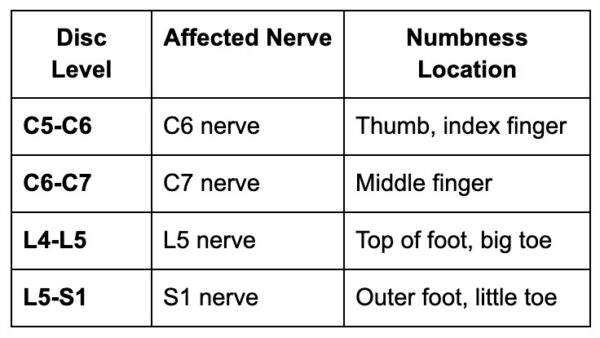
Unlike general soreness, herniated discs create numbness in very specific skin patches called dermatomes. Each nerve root supplies sensation to particular areas.
Dermatome numbness patterns:
The pins-and-needles progression:
- Initial tingling (mild nerve irritation)
- Constant “asleep” feeling (moderate compression)
- Complete numbness (severe compression)
- If left untreated – permanent nerve damage
This specific pattern helps pinpoint exactly which disc has herniated – critical information for targeting treatment.
3. The “Heavy” Limb & Muscle Weakness
When people ask what a herniated disc feel like, they often describe their arm or leg feeling “weighted down” or “like it weighs 100 pounds”.
Why limbs feel heavy: Nerve compression doesn’t just affect sensation – it blocks motor signals. Your brain sends “move” commands, but the nerve interference prevents full muscle activation.
Lower back herniations:
- Foot drop when walking
- Difficulty standing on toes or heels
- Stumbling or tripping frequently
- Can’t maintain single-leg balance
Neck herniations:
- Dropping objects repeatedly
- Weak grip strength
- Difficulty opening jars
- Arm fatigue with minimal use
This isn’t pain-limited weakness – it’s actual loss of motor function. If you’re experiencing progressive weakness, you need evaluation immediately before nerve damage becomes permanent.
4. Deep, Gnawing Night Pain
Many herniated disc patients report their worst pain at night. They toss and turn for hours, unable to find any comfortable position.
Why night pain is so brutal: When you lie down, disc pressure changes. Depending on your herniation pattern, certain positions compress the nerve more, creating relentless aching that prevents sleep.
Night pain characteristics:
- Deep, burning sensation in spine
- Impossible to get comfortable
- Constantly changing positions
- Relief only when standing or walking
- Exhaustion from sleep deprivation
5. The Antalgic Lean
Look in a mirror while standing naturally. Are you leaning to one side? This isn’t conscious – it’s called an antalgic posture, and it’s your body’s automatic response to nerve compression.
Why you lean: Your nervous system positions you to minimize nerve pressure. If tilting left reduces disc compression on the nerve, your muscles will hold you there reflexively – even if it looks odd.
Antalgic lean indicators:
- Can’t stand up straight without severe pain
- Shoulders or hips visibly uneven
- Walking with a tilt
- Automatic lean when standing from sitting
Trying to “correct” your posture creates unbearable pain because it forces the disc harder against the nerve. This isn’t bad posture – it’s protective positioning.
How Spinal Decompression “Reverses” the Pinch
Creating Negative Pressure: The Vacuum Effect
Now that you know what does a herniated disc feel like, here’s what matters most: non-surgical spinal decompression can reverse it.
How decompression works:
- Controlled traction gently separates vertebrae
- Negative pressure develops inside disc space
- This “vacuum effect” pulls herniated material back toward center
- Pressure on nerve root decreases
- Pain, numbness, and weakness improve
Rehydrating the Disc
Discs don’t have blood supply – they get nutrients through diffusion. Herniated, compressed discs become dehydrated and degenerative.
Decompression’s rehydration benefit:
- Pumping action draws oxygen and nutrients in
- Removes metabolic waste products
- Promotes actual tissue healing
- Prevents further degeneration
This isn’t just symptom relief – it’s tissue regeneration at the cellular level.
Why Decompression Succeeds Where PT and Injections Fail
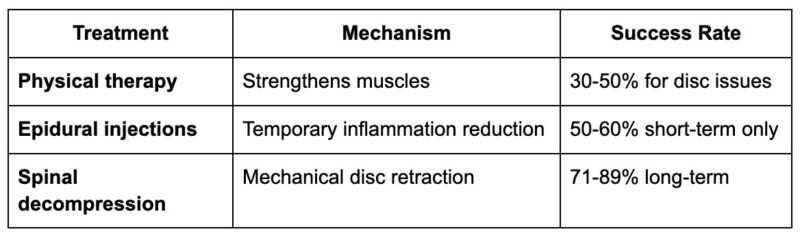
Physical therapy can’t create the negative pressure needed to retract disc material. Injections mask symptoms temporarily but don’t address mechanical compression. Decompression directly fixes the problem.
Stop the Guesswork: Our $47 Spinal Recovery Special
You’ve read about what does a herniated disc feel like – but reading doesn’t provide the definitive answer you need. Professional evaluation does.
Our $47 Spinal Recovery Special includes:
- Complete examination: Neurological testing, orthopedic assessment, range of motion analysis
- Expert consultation: Review symptoms, discuss findings, explain treatment options
- First decompression treatment: Experience relief mechanism firsthand
- Customized recovery plan: If you’re a candidate, we outline exact protocol
At Newport Center Family Chiropractic, we’ve helped thousands avoid surgery through targeted spinal decompression. Many patients experience noticeable improvement within 2-4 weeks of starting treatment.
Ready for real answers instead of more guessing? Take advantage of our $47 Spinal Recovery Special today. We’ll determine exactly what’s causing your symptoms, whether decompression can help, and provide your first treatment – all for less than a typical specialist co-pay.
See more: How to Prevent a Herniated Disc: Expert Spine Protection Strategies Backed by Science
Newport Center
Family Chiropractic
359 San Miguel Drive
Suite #203
Newport Beach, CA 92660
| Monday | 9:00 AM - 5:00 PM |
| Tuesday | 9:00 AM - 5:00 PM |
| Wednesday | 9:00 AM - 5:00 PM |
| Thursday | 9:00 AM - 5:00 PM |
| Friday | 9:00 AM - 5:00 PM |
| Saturday | 9:00 AM - 12:00 PM |
| Sunday | Closed |