
What Causes Knee Pain in Females? 5 Reasons Your Knees Ache
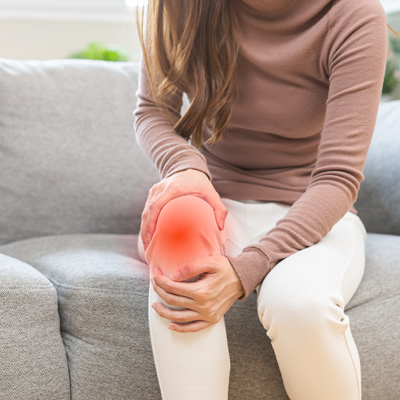
Understanding what causes knee pain in females reveals why women experience knee problems at higher rates than men. It’s not just bad luck – it’s biomechanics, hormones, and structural differences creating specific vulnerabilities.
Let’s break down the five most common causes and what you can do about them.
5 Common Causes of Knee Pain in Women
1. Patellofemoral Pain Syndrome
This is the most common cause of knee pain in active women. Your kneecap (patella) doesn’t track properly through its groove during movement, creating friction, inflammation, and pain.
Why women are more vulnerable: Female pelvic structure is wider than male anatomy. This creates a greater Q-angle – the angle between your hip, knee, and ankle. Higher Q-angles mean more lateral force pulling your kneecap off-track.
Symptoms of runner’s knee:
- Pain behind or around kneecap
- Grinding or clicking sensations
- Worse with stairs, squatting, or prolonged sitting
- Aching after activity
2. Osteoarthritis
Women develop knee osteoarthritis at 2-3 times the rate of men. By age 65, nearly 50% of women show radiographic evidence of knee arthritis.
Why women suffer more arthritis:
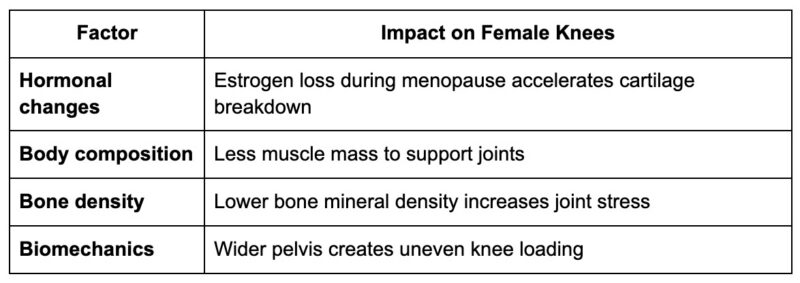
Osteoarthritis progression:
- Cartilage begins thinning
- Joint space narrows
- “Bone-on-bone” friction develops
- Pain, stiffness, and swelling intensify
- Mobility severely limited
3. ACL and Ligament Strains
Women tear their ACL (anterior cruciate ligament) 4-6 times more often than men in the same sports. But even non-athletes experience higher rates of knee ligament injuries.
The hormonal vulnerability: Estrogen levels fluctuate throughout your menstrual cycle, affecting ligament laxity. During ovulation (mid-cycle), when estrogen peaks, ligaments become more elastic and vulnerable to injury.
ACL injury risk factors in women:
- Higher Q-angle creating valgus stress (knees caving inward)
- Weaker hamstring-to-quadricep ratio
- Hormonal ligament laxity
- Different neuromuscular activation patterns
- Landing mechanics favoring ACL strain
4. IT Band Syndrome
Your iliotibial (IT) band runs from your hip down the outside of your thigh to your knee. When tight, it creates friction against the knee joint, causing lateral (outer) knee pain.
Why IT band problems plague women: The wider female pelvis creates greater lateral pull on the IT band. Combined with weak hip abductors (muscles stabilizing your pelvis), this creates chronic tightness and inflammation.
IT band syndrome signs:
- Sharp pain on outer knee
- Worse with running or stairs
- Snapping sensation at knee
- Pain after prolonged sitting
Strengthening hip muscles often resolves IT band syndrome completely—but you need to address the underlying pelvic-knee mechanics.
5. Footwear and Gait Changes
High heels don’t just hurt your feet – they fundamentally alter knee mechanics. Every inch of heel height increases knee joint compression by 23%.
The high heel cascade:
- Heels shift weight forward onto balls of feet
- Knees bend slightly to compensate
- Quadriceps work harder to maintain balance
- Increased compression on kneecap cartilage
- Accelerated cartilage wear over years
Collapsed arches (flat feet) create similar problems:
- Feet roll inward (overpronation)
- Knees rotate inward (valgus stress)
- Uneven cartilage wear develops
- Chronic knee pain results
See more: Knee Pain Relief Without Surgery: Natural Solutions That Work
How Knee on Trac “Decompression” Fixes the Cause
Creating Joint Space: Reducing Bone-on-Bone Friction
Understanding what causes knee pain in females reveals the solution: most knee pain stems from mechanical compression. When joint space narrows, bones grind together, cartilage wears down, and pain intensifies.
Knee on Trac decompression therapy mechanically creates space in the knee joint through controlled traction.
How knee decompression works:
- Specialized equipment applies gentle pulling force
- Joint space between femur and tibia increases
- Pressure on cartilage and meniscus decreases
- Bone-on-bone grinding stops
- Pain and inflammation reduce
Think of it like this: if your shoes are too tight, you need bigger shoes—not stronger foot muscles. Similarly, if your knee joint is compressed, you need more space—not just strengthening exercises.
Rehydrating the Cartilage: Moving Nutrients In
Cartilage doesn’t have blood supply – it gets nutrition through synovial fluid that must be “pumped” in through joint movement and pressure changes.
When knees are chronically compressed, this nutrient flow stops. Cartilage becomes dehydrated, brittle, and prone to breakdown.
Decompression’s rehydration benefit:
- Creates pressure changes that pump fresh synovial fluid
- Delivers oxygen and nutrients to cartilage
- Removes metabolic waste products
- Promotes actual tissue healing and regeneration
This isn’t just pain relief – it’s tissue restoration at the cellular level.
Why Decompression Is a Game-Changer for Chronic Female Knee Pain
At our chiropractor Newport Beach office, we’ve seen women told they need knee replacement surgery to achieve complete pain relief with decompression therapy instead.
Decompression vs. other treatments:
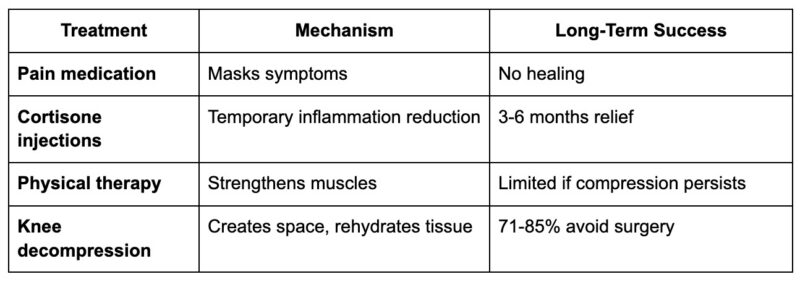
Decompression addresses the mechanical problem causing pain rather than just managing symptoms. This is why results last.
Stop the Guesswork: Our $47 Knee Recovery Special
You’ve read about what causes knee pain in females – but reading doesn’t give you the definitive answer about YOUR knees. Professional evaluation does.
Our $47 Knee Recovery Special includes:
- Complete knee examination: Range of motion testing, stability assessment, gait analysis
- Expert report of findings: Clear explanation of what’s wrong and why
- First knee decompression treatment: Experience the relief mechanism firsthand
- Customized recovery plan: If you’re a candidate, exact protocol and timeline
At Newport Center Family Chiropractic, we’ve helped hundreds of women avoid knee surgery through targeted decompression therapy. Many experience noticeable improvement within 2-3 weeks of starting treatment.
Ready to find out what’s really causing your knee pain? Call Newport Center Family Chiropractic now or book online. Take advantage of our $47 Knee Recovery Special today. We’ll identify your specific problem, determine if decompression can help, and provide your first treatment all for less than a typical co-pay.
Newport Center
Family Chiropractic
359 San Miguel Drive
Suite #203
Newport Beach, CA 92660
| Monday | 9:00 AM - 5:00 PM |
| Tuesday | 9:00 AM - 5:00 PM |
| Wednesday | 9:00 AM - 5:00 PM |
| Thursday | 9:00 AM - 5:00 PM |
| Friday | 9:00 AM - 5:00 PM |
| Saturday | 9:00 AM - 12:00 PM |
| Sunday | Closed |