
Spinal Decompression for L4-L5 Disc Problems: Can It Help?

Spinal decompression for L4-L5 disc problems is a nonsurgical treatment that may help some people manage lower back pain and related nerve symptoms. When a disc between the L4 and L5 vertebrae becomes damaged, it can cause pain, numbness, or discomfort that travels down the leg.
At Newport Center Family Chiropractic, we focus on evaluating spinal conditions and exploring nonsurgical treatment options based on each patient’s needs.
Understanding the L4-L5 disc and common problems
The L4-L5 disc sits between the fourth and fifth vertebrae in your lower back. It acts as a cushion, absorbs pressure, and helps your spine move comfortably.
Because this area supports much of your body’s weight and movement, it is commonly affected by disc problems.
L4-L5 bulging disc
A bulging disc occurs when the disc extends beyond its normal boundaries. It may put pressure on nearby nerves, although many bulging discs cause no symptoms.
L4-L5 herniated disc
A herniated disc develops when material inside the disc pushes through a weakened or torn outer layer. If it irritates a nearby nerve, you may experience pain, tingling, or weakness in your leg.
Understanding the difference between a bulging disc and herniated disc can help you recognize why treatment recommendations may vary.
Disc degeneration can also affect L4-L5 as the disc gradually loses water and flexibility with age.
Common symptoms of L4-L5 disc problems
L4-L5 disc problems do not always cause symptoms. However, when the disc irritates surrounding structures or nerves, you may notice:
- Lower back pain: Aching or sharp discomfort that may worsen with certain movements.
- Sciatica: Pain that travels from your lower back or buttock into your leg.
- Numbness and tingling: Reduced sensation or a pins and needles feeling in your leg or foot.
- Muscle weakness: Difficulty lifting your foot or big toe in some cases.
- Limited mobility: Discomfort when bending, sitting, standing, or walking.
Symptoms depend on which nerve is affected and how much irritation is present.
Because other conditions can cause similar symptoms, a proper examination is important before choosing treatment.
How spinal decompression for L4-L5 disc problems works
Nonsurgical spinal decompression uses a specialized treatment table to apply controlled traction to your spine. The goal is to gently stretch the lower back and reduce mechanical stress on spinal structures.
During treatment, you lie on the table while the equipment applies and releases traction according to a planned treatment setting.
This process may temporarily change the space between spinal structures and reduce pressure in certain areas.
For patients with L4-L5 disc problems, treatment generally aims to:
- Reduce mechanical stress on the affected spinal area.
- Help manage discomfort associated with certain disc conditions.
- Improve movement and daily function when symptoms respond to treatment.
Some explanations of spinal decompression describe negative pressure within the disc. However, this proposed mechanism does not establish that treatment can reliably pull a herniated disc back into place.
Research on nonsurgical spinal decompression remains mixed, particularly regarding its long term benefits. It may help selected patients, but it is not a guaranteed solution for L4-L5 disc damage.
Potential benefits of spinal decompression for L4-L5 problems
Spinal decompression may offer certain benefits for appropriately selected patients. However, results vary depending on the cause and severity of symptoms.
Potential benefits include:
- Pain management: Some patients may experience reduced lower back discomfort.
- Reduced leg symptoms: Treatment may help certain patients manage pain associated with nerve irritation.
- Improved mobility: Less discomfort may make walking, sitting, or other daily activities easier.
- Nonsurgical approach: Treatment does not involve incisions or general anesthesia.
These potential benefits should not be confused with repairing a damaged disc.
Evidence supporting nonsurgical spinal decompression is limited, and it has not been shown to consistently outperform other conservative treatments.
Who may benefit from L4-L5 spinal decompression?
Not everyone with an L4-L5 disc problem is a suitable candidate for spinal decompression.
The decision depends on your symptoms, medical history, examination findings, and any relevant imaging results.
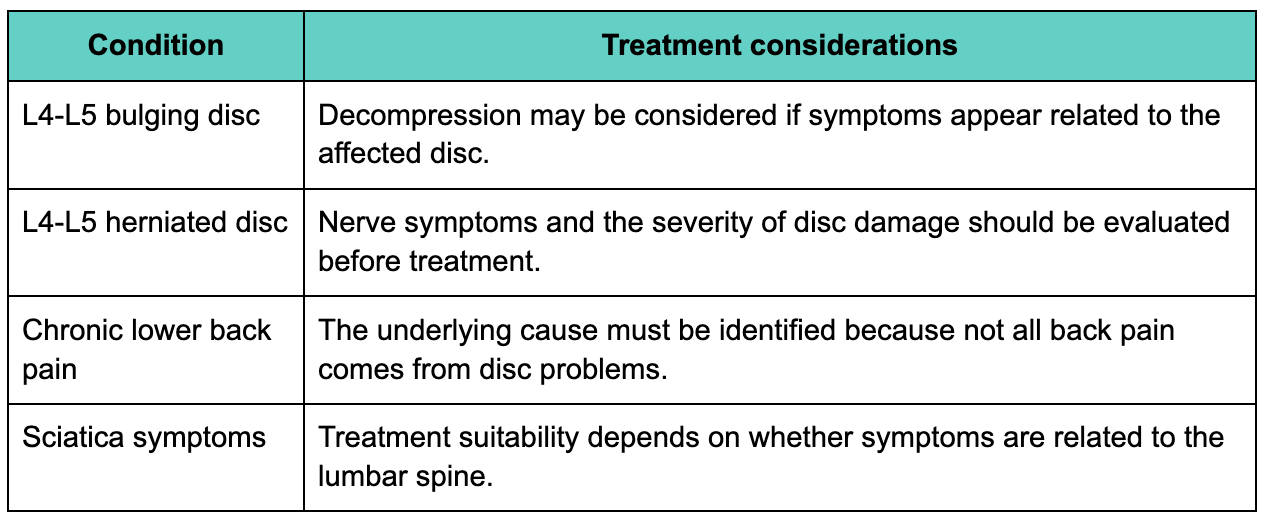
Certain conditions, including spinal fractures, significant spinal instability, or severe osteoporosis, may make traction treatment unsuitable.
Seek emergency medical care if you develop new bladder or bowel control problems, numbness around your groin, or rapidly worsening leg weakness. These symptoms may indicate serious nerve compression.
What to expect during L4-L5 spinal decompression treatment
At Newport Center Family Chiropractic, we begin by evaluating your symptoms to determine whether spinal decompression is appropriate. The treatment process generally includes three steps:
- Initial evaluation: We review your medical history, symptoms, and activities that worsen your pain. We may also assess your mobility and review existing imaging results when needed.
- Personalized treatment: If spinal decompression is appropriate, we develop a treatment plan based on your condition. During each session, you lie on a specialized table that applies gentle, controlled traction to your lower back.
- Progress monitoring: We track changes in your pain, mobility, and daily activities. Your treatment plan may be adjusted based on your response and progress.
The number of sessions varies depending on your condition. There is no single treatment schedule that works for everyone.
Other treatment options for L4-L5 disc problems
Spinal decompression is not the only nonsurgical approach to managing L4-L5 disc problems.
Depending on your condition, other options may include:
- Physical therapy: Exercises that improve strength, flexibility, and spinal support.
- Activity modification: Adjusting movements that increase pain while maintaining comfortable activity.
- Medication: Pain relief or anti-inflammatory medication when recommended by a healthcare professional.
- Surgical evaluation: Considered when serious nerve problems develop or symptoms remain disabling despite appropriate conservative care.
Many people with lumbar disc problems improve without surgery.
The best treatment depends on your symptoms, examination findings, and how your condition affects daily life.
Exploring nonsurgical care for L4-L5 disc problems
L4-L5 disc problems can affect your comfort, movement, and daily activities. While nonsurgical spinal decompression may help some patients manage symptoms, the right approach depends on identifying the underlying cause.
At Newport Center Family Chiropractic, Dr. Mike Digrado has been helping patients with spinal conditions since 2002. With more than 20 years of clinical experience, he focuses on nonsurgical spinal decompression and deep tissue laser therapy to address each patient’s needs.
If you are experiencing persistent lower back pain or symptoms that travel into your leg, contact us to discuss your concerns and find out whether an evaluation may be appropriate.
Frequently asked questions
Can spinal decompression help an L4-L5 herniated disc?
It may help some patients manage pain and related symptoms. However, evidence is limited, and treatment does not guarantee that the herniated disc will heal.
Can spinal decompression fix an L4-L5 bulging disc?
Spinal decompression may help relieve symptoms, but it has not been proven to permanently repair or reverse a bulging disc.
How many spinal decompression sessions are needed for L4-L5?
The number of sessions varies based on your condition, symptoms, and response to treatment. Your provider should reassess progress throughout your care.
Is spinal decompression safe for L4-L5 disc problems?
It may be appropriate for selected patients, but it is not suitable for everyone. A medical evaluation helps identify possible risks and contraindications.
Can L4-L5 disc problems improve without surgery?
Yes. Many people improve with time and conservative care, including physical therapy, activity changes, and appropriate pain management.
Newport Center
Family Chiropractic
359 San Miguel Drive
Suite #203
Newport Beach, CA 92660
| Monday | 9:00 AM - 5:00 PM |
| Tuesday | 9:00 AM - 5:00 PM |
| Wednesday | 9:00 AM - 5:00 PM |
| Thursday | 9:00 AM - 5:00 PM |
| Friday | 9:00 AM - 5:00 PM |
| Saturday | 9:00 AM - 12:00 PM |
| Sunday | Closed |
