
Severe & Chronic Back Pain: When Is It Time to Consider Spinal Decompression Therapy?

You’ve tried the medications. You’ve done the exercises. Maybe you’ve been through rounds of physical therapy. And still – the pain remains. If you’re living with severe chronic back pain and wondering whether surgery is your only option left, this article is for you.
The truth is, most people reach us after months or years of managing pain that never fully resolves. And for many of them, non-surgical spinal decompression therapy becomes the turning point they didn’t know existed.
Understanding Severe and Chronic Back Pain
What Qualifies as Chronic Back Pain?
Chronic back pain isn’t just pain that’s been around a while. Clinically, it’s defined as:
- Pain lasting more than 12 weeks
- Recurring flare-ups over months or years, even with treatment
- Pain that disrupts sleep, work, or basic daily movement
If that sounds familiar, you’re not imagining it and you’re not alone.
Signs Your Pain May Be Severe
Severity isn’t just about intensity. Watch for these red flags:
- Radiating pain – sciatica shooting down the leg or arm
- Numbness or tingling in the legs, feet, hands, or fingers
- Limited mobility – difficulty bending, sitting, or standing for any length of time
- Disrupted sleep – waking from pain or unable to find a comfortable position
These symptoms often point to nerve involvement – which changes how your condition needs to be treated.
Why Chronic Pain Often Gets Worse Over Time
Left unaddressed, the underlying causes of chronic back pain tend to compound. Progressive disc degeneration narrows the space around nerves. Increased nerve irritation creates chronic pain signals that become harder to interrupt. And as the body compensates – shifting posture, avoiding movements – new imbalances develop on top of the original problem.
Waiting rarely makes this simpler to treat.
Why Traditional Treatments Often Fall Short
The Limitations of Pain Medication
Medication can quiet the signal. It cannot fix the source. For people with structural compression issues – herniated discs, spinal stenosis, nerve impingement – pain medication is, at best, a management tool. At worst, long-term use carries dependency risks and masks a problem that continues progressing underneath.
When Physical Therapy Is Not Enough
Physical therapy is genuinely valuable for many conditions. But for structural compression – where a disc is physically pressing on a nerve – movement-based therapy has real limits. Strengthening muscles around a compressed nerve doesn’t decompress it. For these cases, targeted pressure relief is what’s actually needed.
The Reality of Surgery
Surgery is sometimes the right call. But it’s worth understanding what it involves before accepting it as the default next step:
- High cost and significant recovery time – often months before normal function returns
- Real complication risk – including infection, failed fusion, and adjacent segment breakdown
- No guaranteed outcome – a meaningful percentage of spinal surgeries result in continued or worsening pain
For many patients dealing with severe chronic back pain, a structured non-surgical approach deserves serious consideration before the operating room.
The Root Cause of Severe Back and Sciatica Pain
Herniated and Bulging Discs Explained
The discs between your vertebrae act as shock absorbers. When a disc herniates or bulges, the inner material pushes outward – pressing against nearby nerves. The result is localized pain, radiating pain, or both. This is one of the most common structural causes of sciatica pain and chronic lower back dysfunction.
Spinal Compression and Nerve Impingement
When vertebrae are compressed – from injury, degeneration, or prolonged postural stress – the spaces through which nerves exit the spine narrow. Compressed nerves fire chronic pain signals. The longer that compression persists, the more sensitized those pathways become.
Degenerative Disc Conditions
Age and injury both break down disc tissue over time. As discs lose height and hydration, the spine loses cushioning – increasing bone-on-bone stress and further narrowing nerve pathways. This is not just an “older patient” problem. We see it regularly in adults in their 30s and 40s with sedentary or physically demanding lifestyles.
Why Technology Matters in Decompression Therapy
Not all decompression treatments are created equal. The equipment used directly affects how precisely and how comfortably – the therapy can be delivered.
Introducing the Triton DTS Decompression Table
At Newport Center Family Chiropractic, we use the Triton DTS Decompression Table – an advanced system designed to deliver precise, controlled spinal decompression for both lumbar and cervical conditions.
Key features that set it apart:
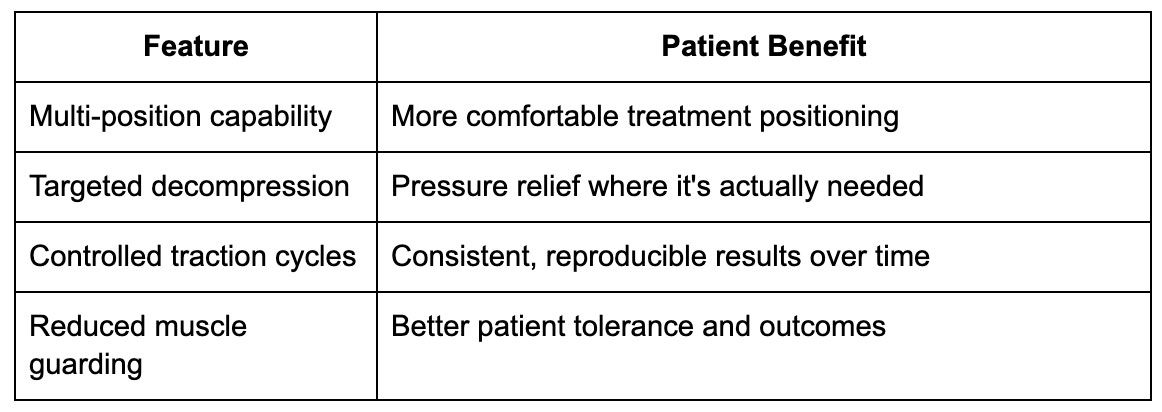
- Multi-position treatment – patients can be treated face up or face down, depending on what targets the affected segment most effectively
- Precision targeting – treatment is directed at specific spinal levels, not a generalized pull on the spine
- Smooth, controlled traction – the system ramps force gradually, reducing muscle guarding and improving patient comfort throughout
Benefits for Patients With Severe Pain
For people who have struggled through painful or ineffective treatments before, these distinctions matter:
A 2014 study by Dr. John Mayer, published in the Journal of Physical Therapy Science, found that motorized spinal decompression produced significantly greater disc height restoration and pain reduction compared to manual traction – particularly in patients with herniated disc involvement.
Conditions That May Benefit From Spinal Decompression
Spinal decompression therapy is clinically applied to a range of diagnoses. Patients we work with most often present with:
- Chronic lower back pain – especially with confirmed disc involvement
- Sciatica – radiating leg pain from lumbar nerve compression
- Herniated or bulging discs – cervical or lumbar
- Degenerative disc disease
- Neck pain related to disc or nerve issues
As your experienced Chiropractor Newport Beach, Dr. Mike Digrado conducts a thorough evaluation before recommending decompression – because the right tool depends on the right diagnosis.
Take the First Step Toward Lasting Pain Relief
Why Early Intervention Matters
The longer structural compression continues, the more the surrounding tissues adapt to dysfunction. Earlier intervention means less degeneration to reverse, a faster path to relief, and better long-term outcomes. Waiting for symptoms to become unbearable is rarely the right strategy with disc and nerve conditions.
What Your First Visit May Include
We believe in clarity from the start. A first visit typically involves:
- Comprehensive spinal exam – assessing range of motion, neurological function, and structural integrity
- Consultation and report of findings – we explain exactly what we find and what it means for your care
- Initial decompression session – where appropriate, we begin treatment on the first visit
No vague timelines. No pressure. Just a clear clinical picture and an honest conversation about whether spinal decompression is the right fit for your condition.
Don’t Let Severe Chronic Back Pain Define Your Life
If you’ve been told surgery is your only option or if you’re simply exhausted from managing pain that never fully resolves – we’d like to offer a different path forward.
At Newport Center Family Chiropractic, Dr. Mike Digrado specializes in clinically guided, non-surgical care for complex back and neck conditions. Our personalized treatment plans are built around your specific diagnosis, your history, and your goals – not a one-size-fits-all protocol.
Schedule your consultation today and find out whether spinal decompression therapy can be the turning point your back has been waiting for.
*** This article is for educational purposes and does not replace a personalized medical evaluation.
Newport Center
Family Chiropractic
359 San Miguel Drive
Suite #203
Newport Beach, CA 92660
| Monday | 9:00 AM - 5:00 PM |
| Tuesday | 9:00 AM - 5:00 PM |
| Wednesday | 9:00 AM - 5:00 PM |
| Thursday | 9:00 AM - 5:00 PM |
| Friday | 9:00 AM - 5:00 PM |
| Saturday | 9:00 AM - 12:00 PM |
| Sunday | Closed |
