
L5-S1 Disc Herniation: Signs, Symptoms and Treatment Options
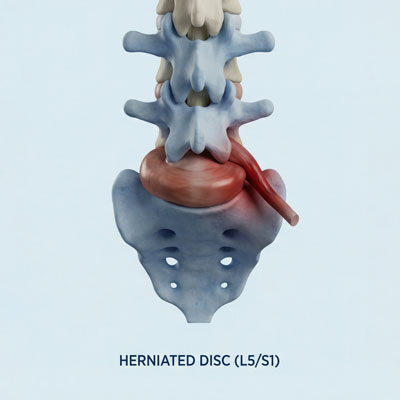
L5-S1 disc herniation occurs when a disc in your lower spine pushes beyond its normal position and may irritate nearby nerves. This can cause lower back pain, sciatica, numbness, or weakness that affects your daily activities.
While some people recover with conservative care, others may need additional treatment depending on their symptoms.
At Newport Center Family Chiropractic, we help patients explore non-surgical options for managing disc-related pain and improving their comfort and mobility.
What is an L5-S1 disc herniation?
L5-S1 refers to the area between the fifth lumbar vertebra (L5) and the first sacral vertebra (S1). It sits near the bottom of your spine, just above your pelvis.
Between these bones is a disc that acts as a cushion. It helps absorb pressure and allows your lower back to move.
An L5-S1 disc herniation happens when the soft inner material of this disc pushes through a weakened or torn area of its outer layer.
If the displaced material irritates or compresses a nearby nerve, you may experience pain, tingling, numbness, or weakness in your leg.
A herniated disc is different from a bulging disc. Understanding the difference between a bulging disc vs herniated disc can help you better understand your diagnosis.
Common signs and symptoms of L5-S1 disc herniation
L5-S1 disc herniation symptoms depend on the location of the herniation and whether it affects nearby nerves.
Common symptoms include:
- Lower back pain: Aching or sharp pain near your waistline that may worsen with certain movements.
- Sciatica: Pain that travels from your lower back or buttock down one leg, sometimes reaching your foot.
- Numbness and tingling: Reduced sensation or a pins and needles feeling in your leg, foot, or toes.
- Muscle weakness: Difficulty lifting your foot, standing on your toes, or pushing off while walking.
- Pain during certain movements: Sitting, bending, lifting, or coughing may increase discomfort.
Some people have an L5-S1 disc herniation without noticeable symptoms. Others experience significant nerve pain even when their lower back pain is mild.
How to differentiate L5-S1 nerve pain from standard back strain
Lower back pain from an L5-S1 disc herniation can feel similar to a muscle strain. However, certain symptoms may help distinguish the two conditions.
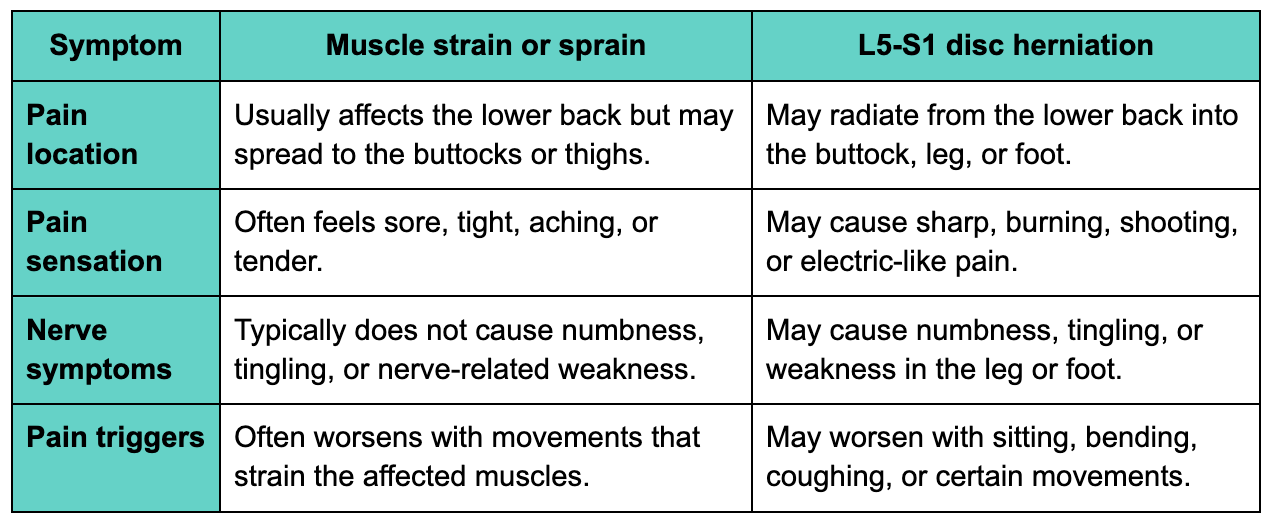
These differences can provide useful clues, but symptoms may overlap. A medical examination is needed to determine the underlying cause.
What causes an L5-S1 disc herniation?
The L5-S1 disc supports much of your upper body’s weight and experiences stress during everyday movement.
Several factors may contribute to disc herniation:
- Age-related disc changes: Discs gradually lose water and flexibility, making them more vulnerable to damage.
- Repeated physical strain: Frequent bending, lifting, or twisting may place additional stress on the lower spine.
- Heavy lifting: Lifting heavy objects, especially while twisting, can increase pressure on spinal discs.
- Previous injuries: Earlier disc injuries may increase the risk of future problems.
- Genetic factors: Some people inherit characteristics that make disc degeneration more likely.
Disc herniation does not always result from a single injury. It may develop gradually as the disc changes over time.
Treatment options for L5-S1 disc herniation
Many people with L5-S1 disc herniation improve without surgery. Treatment focuses on reducing pain, managing nerve irritation, and improving mobility. The best approach depends on your symptoms and condition.
Activity modification and pain management
Gentle movement is often better than prolonged bed rest. To manage symptoms:
- Take short, comfortable walks.
- Avoid activities that worsen leg pain.
- Change positions regularly.
- Use pain medication as recommended by your healthcare provider.
Physical therapy and rehabilitation
Physical therapy may help strengthen your core, improve flexibility, and support spinal movement. Exercises should be adjusted to avoid worsening pain, numbness, or weakness.
Non-surgical spinal decompression
Non-surgical spinal decompression uses controlled traction to reduce pressure on spinal structures. It may provide symptom relief for some patients, although long-term benefits remain uncertain.
At Newport Center Family Chiropractic, we assess whether spinal decompression for herniated discs is appropriate for your condition.
Deep tissue laser therapy
Deep tissue laser therapy uses targeted light energy to help manage musculoskeletal pain. It may complement other treatments, but evidence for its effectiveness in treating L5-S1 disc herniation remains limited.
When surgery or emergency care is needed for L5-S1 disc herniation
Most people with L5-S1 disc herniation improve without surgery. However, surgery may be considered if:
- Severe leg pain persists despite conservative treatment.
- Symptoms significantly affect daily activities.
- Muscle weakness progressively worsens.
- Imaging and examination confirm nerve compression that may require surgery.
Seek emergency medical care if you experience:
- Loss of bladder or bowel control: New difficulty controlling urination or bowel movements.
- Saddle numbness: Loss of sensation around the groin or inner thighs.
- Rapidly worsening leg weakness: Sudden difficulty walking or moving your foot.
These symptoms may indicate serious nerve compression, including cauda equina syndrome, and require immediate medical evaluation.
Living with an L5-S1 disc herniation
Small adjustments to your daily routine may help you stay comfortable while recovering.
Consider these habits:
- Keep moving: Choose gentle activities that do not worsen your symptoms.
- Take sitting breaks: Stand or change positions regularly, especially during long workdays.
- Avoid painful movements: Temporarily reduce activities that trigger shooting pain or increasing numbness.
- Follow your treatment plan: Perform recommended exercises and attend follow-up appointments when needed.
Recovery is different for everyone. Gradually returning to normal activities is generally more helpful than avoiding movement entirely.
Personalized care for L5-S1 disc problems in Newport Beach
Living with L5-S1 disc herniation can make everyday movements uncomfortable, but understanding your symptoms is an important first step toward appropriate care.
At Newport Center Family Chiropractic, we focus on evaluating your spinal condition and discussing treatment options based on your individual needs. Our services include non-surgical spinal decompression and deep tissue laser therapy for appropriately selected patients.
If you are experiencing ongoing lower back pain or symptoms that may be related to a herniated disc, contact us to schedule an evaluation and discuss your options.
Frequently asked questions
Is L5-S1 disc herniation serious?
Not always. Many cases improve without surgery, but worsening weakness or bladder and bowel changes require urgent medical care.
Can an L5-S1 disc herniation heal on its own?
Yes. Some herniated discs shrink naturally, and symptoms may improve over time without surgery.
How long does L5-S1 disc herniation take to heal?
Symptoms may improve within several weeks, but full recovery can take months, depending on the severity.
What is the best sleeping position for L5-S1 disc herniation?
Try sleeping on your side with a pillow between your knees or on your back with a pillow under your knees.
Does L5-S1 disc herniation always require surgery?
No. Many cases improve with conservative care. Surgery may be needed for severe or persistent symptoms.
Newport Center
Family Chiropractic
359 San Miguel Drive
Suite #203
Newport Beach, CA 92660
| Monday | 9:00 AM - 5:00 PM |
| Tuesday | 9:00 AM - 5:00 PM |
| Wednesday | 9:00 AM - 5:00 PM |
| Thursday | 9:00 AM - 5:00 PM |
| Friday | 9:00 AM - 5:00 PM |
| Saturday | 9:00 AM - 12:00 PM |
| Sunday | Closed |
